-
Products
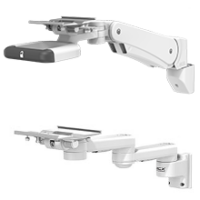
Arms
Variable Height
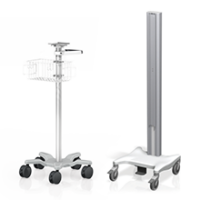
Carts and Roll Stands
Variable Height
Fixed Height
Accessories
- 10 x 25 mm Rails
- Barcode Scanner Mounts
- Baskets and Bins
- Cable Management
- Camera Mounts
- Channels
- CPU Mounts
- Data Capture Device Mounts
- Down Posts
- Drawers
- Gas Cylinder Mounts
- Gel Bottle Mount
- Handles
- Keyboard Trays and Plates
- Medical-Grade Power Strips
- Mountable Tablet Enclosures
- PolyQuip® Post and I.V. Bag Hanger Mounts
- Power Supply Mounts
- Probe Cup Mount
- Speaker Mount
- Tablet Integration
- Trays
- UPS Mounts
- USB Charging Modules
- VESA Adapter Plates
-
Solutions
Care Area Solutions
Standardize GCX mounting solutions throughout your healthcare facility.
IT and EMR Solutions
Mounting solutions for Information Technology and Electronic Medical Records equipment.
Mounting solutions based on your mounting location.
Medical Device Solutions
Mounting solutions designed specifically for your medical and patient monitoring devices.
- Build
- Learn
-
About
Lilitab™ is now a part of GCX! Learn More
GCX Patient Engagement Overbed Tables help pediatric ER nurses comfort young patients and their families
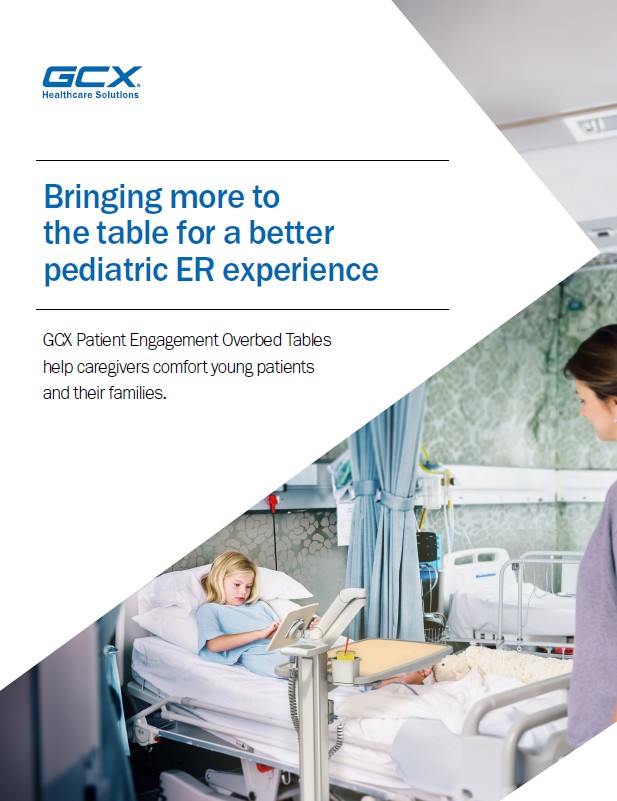
GCX Patient Engagement Overbed Tables help pediatric ER nurses comfort young patients and their families
One of the nation’s largest emergency departments recently expanded its pediatric ER to 48 beds, positioning it to become the busiest pediatric ER in the country. Smart TVs mounted on the footwalls enable two-way communication for virtual visits and offer multiple entertainment options for patients and their families.
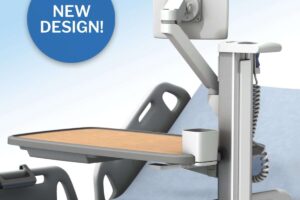
Electronic ‘My Stay’ boards are updated in real time to keep patients, parents and care teams aligned on treatment and discharge plans. Digital door signs provide important patient information, at a glance, to care team members as they enter each room. But for the clinical director of the pediatric emergency department, one of the most transformational technologies in these upgraded rooms is a table—the GCX Patient Engagement Overbed Table, a rolling overbed table equipped with an adjustable tablet mounting arm.From the moment the director saw the table, she saw its potential. And in the short time since the tables were deployed in the ER, they’ve exceeded her expectations.
“We were looking for ways to improve the entire experience for our patients and our care team,” said the director. “When I saw the GCX table, I knew it was exactly what we needed. And the experience of having it in every one of our rooms has been incredible.”
Two solutions in one product
Initially, the hospital was in the market for a traditional adjustable bedside or overbed table.
“We were looking for a table nurses could use to put out their supplies when they’re performing a sterile procedure, like starting an IV or accessing a mediport,” said the director. “We have IV carts in every room, but they’re limited because when a doctor needs to, say, do a lumbar puncture, they need a surface that’s sterile, height adjustable and close to the patient.” But when she saw the GCX table and its integrated tablet arm, she saw the solution to another problem: Providing tablets for easy access to information and entertainment, without the risk of device theft.
“At one point in our old ER we had an iPad for every patient, locked in a case. But they were constantly being stolen. And once they were stolen, they weren’t being replaced, because they’re so expensive.”
The GCX table’s tablet arm adjusts to let the young patients, their parents and their caregivers view the tablet from virtually any angle—but secures the tablet in a locked enclosure, so the tablet stays with the table.
“We were getting two things we needed for the price of one.”
Great product, great relationship
According to the hospital’s IT director, the Patient Engagement Overbed Table delivers the design features and durability he’s come to expect from GCX. Just as important—to the IT director and the clinical staff—is how easy it is to work with GCX.- Flexible and practical
“Nurses can position the tablet at virtually any viewing angle, and move it out of the way when they need to.” - Convenient
“There’s a USB-A/C charger right on the table. For parents that’s indispensable.” - Light but strong
“The table is light enough to move around without it being a chore, but firm and stable, so it moves without rocking or tipping.” - Safe by design
“You raise the table by grabbing anywhere and lifting, but to lower it you need to pull a handle, so there’s no risk of dropping it on the patient.”
Less chaos, more control
Nobody is happy to visit an emergency room. But arriving at a pediatric ER is ‘next-level stressful’ for young patients and their parents. “When families come in with their child, there’s an instant sense of losing control. The process, the environment, the strange faces, the schedule, and for some patients a foreign language—everything is different and unsettling. So from the moment they arrive, we do everything we can to empower them with information and resources that help them control the environment as best they can.”The Samsung Galaxy Tab tablets mounted to the GCX tables connect to the hospital’s Patient Engagement Platform, which provides on-demand access to
interpretive services for non-English speaking patients- healthcare information from EPIC MyChart
- microlearning about medical conditions, treatment procedures and medications
- special apps for games, entertainment and relaxation
Together, the tablets and the tables help the young patients, their families, and their nurses with all kinds of tools for avoiding confusion, dealing with tension, and creating the best possible experience for everyone in the ER.
Interpretive services, anytime and anywhere
All hospitals and acute care facilities are required by law to provide interpretive services for patients with limited English proficiency (LEP), particularly when communicating information relevant to a patient’s health and treatment. In a pediatric ER, these services are also a great comfort to non-English speaking patients and their families. The hospital’s tablets let patients, their families and clinicians connect instantly to online video remote interpreting (VRI) services for nine spoken languages, plus American and European sign language—24/7.According to the pediatric ER staff, that around-the-clock availability is essential. “So many things we need to tell patients are unplanned but very important—things like Mom, I know the doctor said your child is getting an ultrasound, but first I need to insert this tiny catheter so we can obtain urine. Nurses don’t have time to wait or run around looking for an in-person interpreter before performing these procedures. Having instant access to an online interpreter in every room, anytime, is so important.”
It also saves money.
“In-person interpreters are consistently among the most expensive line items in our monthly budget. Having remote interpreting is a lot more cost effective. And with the broader language support we’re able to communicate with families we were never able to communicate with before.”Positive distraction
Getting a child to start gaming on the tablet can be a real gamechanger for a nurse trying to start an IV or draw blood from a tiny arm. But some nurses use the adjustable table surface to hide these scary procedures entirely.“We can raise the table to the patient’s chin level, and perform venipuncture and other procedures under the table,” said an ER nurse. “This really helps with children and even parents who have needle phobia—it avoids the need for repeated sticks. And with the tables I can do most IVs myself, without another nurse, something I was never able to do before.”
Relaxation, on-demand
Every tablet includes a relaxation app that can guide the patient through deep breathing exercises or play soothing sounds that calm the patient’s nerves. “If a child comes in with a migraine, we can have them listen to rain or send them to Hawaii for an hour. If we have an anxious 8-year-old who needs an IV, and we know it might hurt, we can have the patient do deep breathing while the nurse sets up the IV outside the room. It puts the child in a better place.” The nurses also use the relaxation app to calm parents. “An anxious parent will make their child anxious, too.”Reward for good behavior
The ER’s behavioral health rooms do not have their own tables because the coiled charging cord can be a ligature risk for those patients. But behavioral health nurses love to use the tables as a reward for well-behaved patients. “These patients arrive sad or depressed or suicidal,” said the clinical director. “Some may be aggressive, and a few even arrive in police custody. We need to get their clothing off, put them in a gown, put them in a very sterile room with a garage-door like closure, and ask them a lot of very hard questions. It’s a lot to ask of a young person. And it really helps for a nurse to be able to say, look, after you answer these questions, you can play a game or watch a movie.”Convenience eases tension
When a family comes into the pediatric ER, the parents’ phones are blowing up with calls and texts from concerned family and friends. “It can be a source of tension if parents need to choose between giving the phone to their child as a distraction, or keeping it to update family, make payments, and so on. In our rooms parents
don’t have to choose because the children always have their own devices.” Knowing there’s a tablet in every room eliminates tension for nurses, too—especially compared to the alternative of sharing a handful of tablet carts across multiple rooms.“Our nurses are responsible for 20 patients a day, minimum. When they need to calm down a child or a family, or use interpretive services, they don’t have to spend time looking for a pole with a tablet on it and hoping the tablet is charged when they find it. It’s always there, always charged, in every room.”
Bringing comfort and joy to the ER
The ER nurses agree that GCX’s unique table and tablet combination creates a powerful engagement point for the patient, family and nurses in each room.
“We can move the table to the bed or to a chair, and everyone can watch movies or play video games on the tablet or just play board games on the table,” said one nurse. “It really does draw the family together in the room. Just making them aware of the tablet table, moving it where they want it, and showing them the games and entertainment, can be a real bonding moment between us and the family.”Another nurse had her own way of describing the table’s impact.
“For lack of a better word, it’s joy. The parents see their child happy and comfortable and safe, and we see the parents and the kids smiling and happier during what can be a really difficult time. It really is joyful.”For a sales rep, the benefit hits home
The GCX sales representative who worked with the emergency department admits that he didn’t fully appreciate the impact of the Overbed Engagement Tables, until he saw one of the finished ER rooms for the first time.“There was a mom sitting on the hospital bed, with her child on her lap. The table was pulled up to the bed, and they were both watching the tablet. The child was visibly ill, but she and her mom were spending time together, content and relaxed, as if all the other crazy stuff going on around them just didn’t matter.”
For the sales representative—who has a three-year-old son with a medical issue and has logged many hours in pediatric ERs— the moment was powerful and unforgettable.
“To this day I get emotional describing it. This is so much more than just a table and a tablet. There’s a psychological benefit that I really didn’t grasp until I saw it that day.”Related Articles
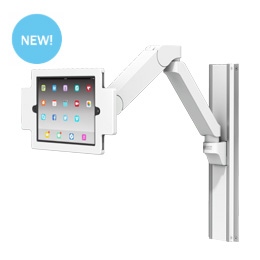
Fulfilling a Clinical Need: A Medical-Grade Support Arm for a Tablet
Since GCX’s foray into patient engagement projects officially launched some three years ago, we’ve been listening to how we can best help our customers fulfill a growing need with our…
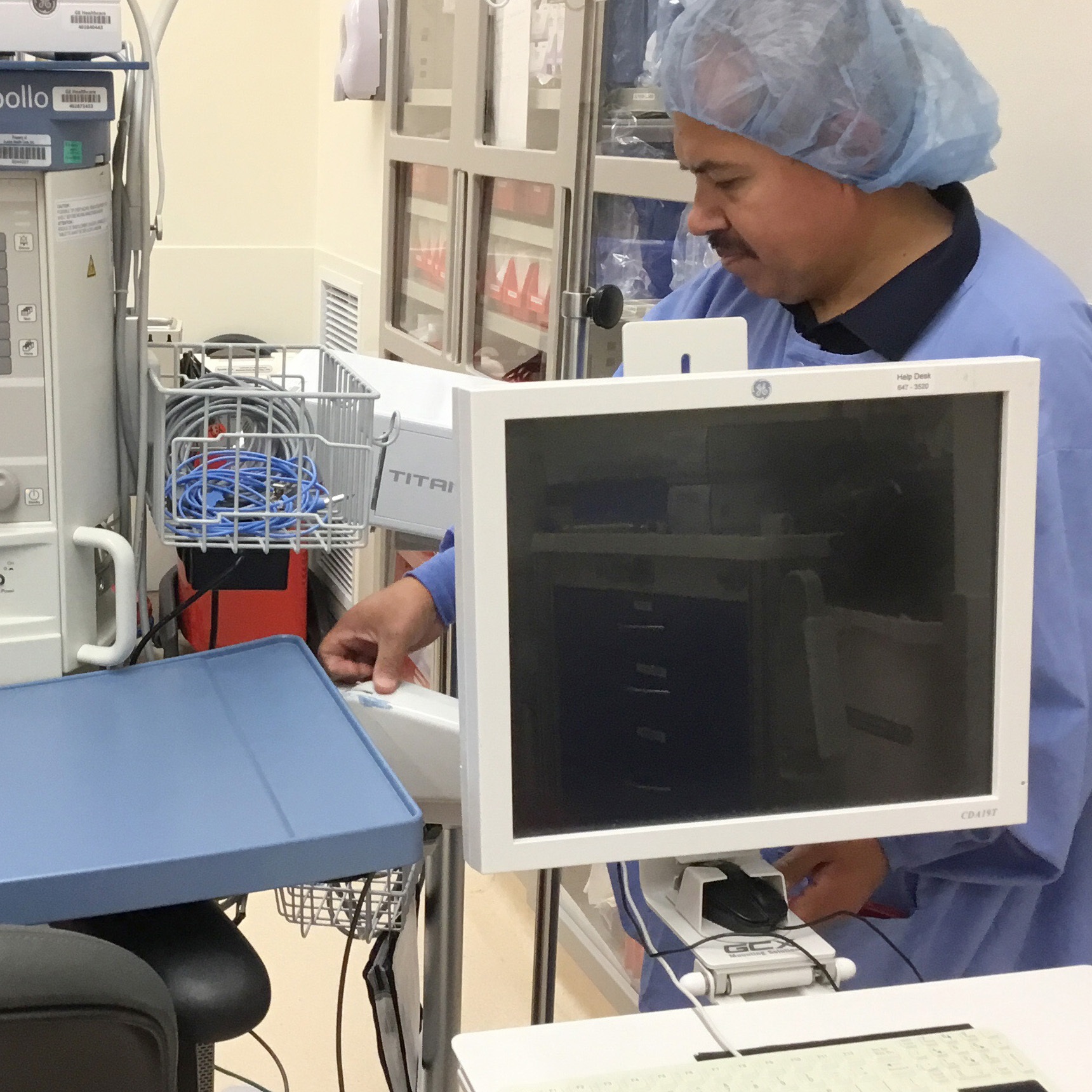
Finding Time for a Mounting Arm Audit
All mounting solutions, no matter how durable, have a limited lifespan. That’s why we recommend periodic audits of arms and other mounting solutions to ensure each piece of hardware continues…
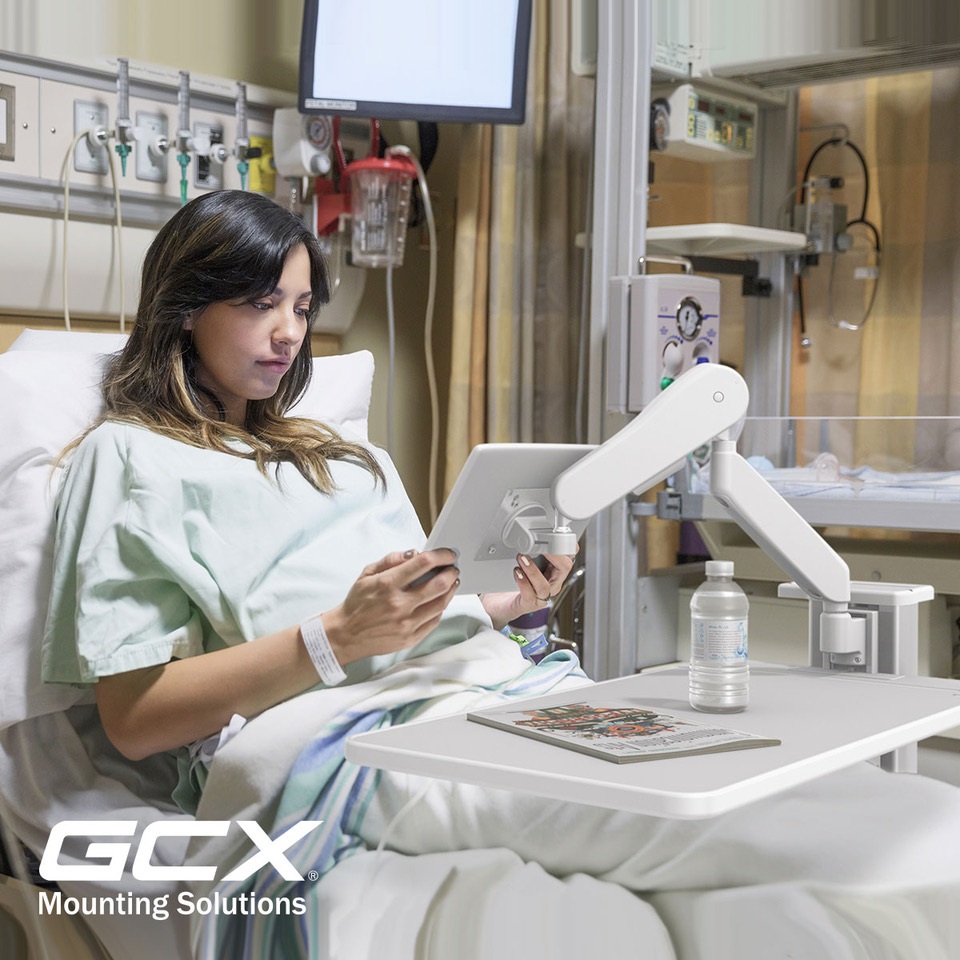
Exploring a Higher Level of Patient Experience
In a Richmond, Va., hospital’s ICU, tetraplegics unable to move by themselves are communicating and staying connected to the outside world by controlling an overhead laptop’s cursor using their eye…

GCX Displays Ways to Enhance the Patient Experience at HIMSS18
One place where healthcare and solutions providers will converge to discover new ways to improve patient care and, ultimately, patient outcomes is HIMSS18. GCX is proud to exhibit and be…
- Flexible and practical