-
Products
Arms
Variable Height
Carts and Roll Stands
Variable Height
Fixed Height
Accessories
- 10 x 25 mm Rails
- Barcode Scanner Mounts
- Baskets and Bins
- Cable Management
- Camera Mounts
- Channels
- CPU Mounts
- Data Capture Device Mounts
- Down Posts
- Drawers
- Gas Cylinder Mounts
- Gel Bottle Mount
- Handles
- Keyboard Trays and Plates
- Medical-Grade Power Strips
- Mountable Tablet Enclosures
- PolyQuip® Post and I.V. Bag Hanger Mounts
- Power Supply Mounts
- Probe Cup Mount
- Speaker Mount
- Tablet Integration
- Trays
- UPS Mounts
- USB Charging Modules
- VESA Adapter Plates
-
Solutions
Care Area Solutions
Standardize GCX mounting solutions throughout your healthcare facility.
IT and EMR Solutions
Mounting solutions for Information Technology and Electronic Medical Records equipment.
Mounting solutions based on your mounting location.
Medical Device Solutions
Mounting solutions designed specifically for your medical and patient monitoring devices.
- Build
- Learn
-
About
Lilitab™ is now a part of GCX! Learn More
City of Hope Duarte and GCX Build a Custom Phlebotomy Cart
A cancer center’s phlebotomy expertise, a manufacturer’s rapid prototyping capabilities and a collaborative design process yield a first-of-its-kind mobile phlebotomy workstation—in a few short months.
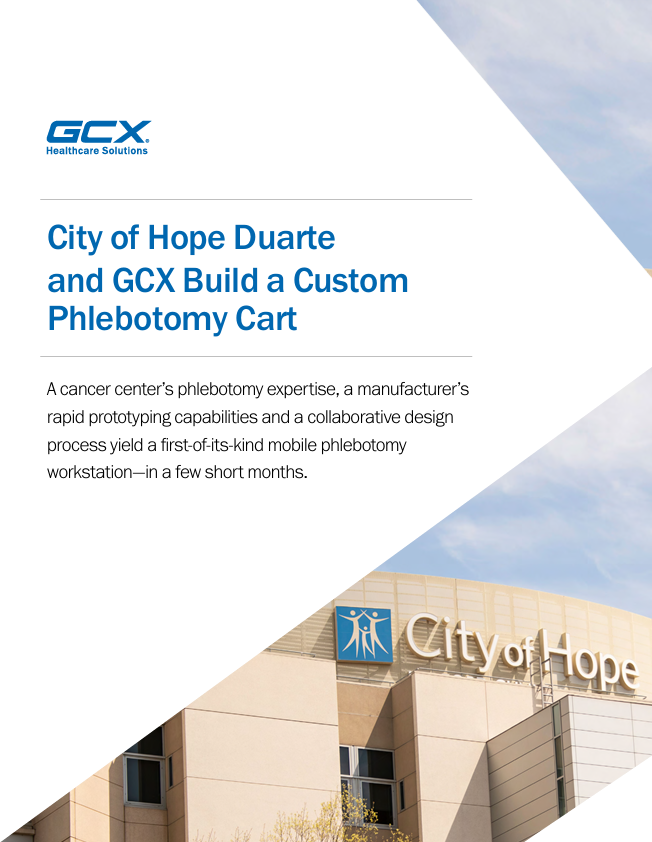
City of Hope, one of the largest cancer research and treatment organizations in the United States, is one of just 56 National Cancer Institute-designated comprehensive cancer centers and is a founding member of the National Comprehensive Cancer Network, which offers research and treatment protocols that advance care throughout the nation. With locations in California, Arizona, Illinois and Georgia, City of Hope employs more than 12,000 researchers, scientists, doctors, nurses, allied health professionals, graduate students, philanthropy specialists, marketing and communications professionals, and support staff.
Starting in 2012, the phlebotomists at City of Hope’s main campus in Duarte, California, used medical carts manufactured by Jaco, Incorporated, a pioneering manufacturer of mobile and wall mounted medical computer workstations. In 2022, Jaco was purchased by GCX Corporation, a worldwide leader in medical instrument and IT mounting solutions.
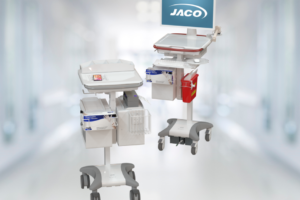
Today, City of Hope’s phlebotomists are using the GCX Jaco EVO Smartphone phlebotomy cart—a truly innovative solution that the phlebotomy team helped design. We spoke to Danika Glover, Phlebotomy Manager at City of Hope in Duarte, and Stephanie Salazar and Jonathan Ruiz, Phlebotomy Leads, about what drove their need to upgrade their carts—and how they ended up with exactly the new phlebotomy carts they wanted.
Phlebotomists’ wish list
Phlebotomists can walk from five to seven miles every shift. After walking 10+ years and thousands of miles with their previous carts, Glover, Salazar, Ruiz and the rest of the phlebotomy team knew exactly what they wanted from their new ones.
Easier height adjustment. City of Hope’s Duarte main campus employs 45 phlebotomists across three shifts, sharing eight carts among them. “Having the cart at just the right height is essential for working comfortably and pain-free through the shift,” said Salazar. “The first shift adjusts the carts to the best height for them, then the second shift readjusts them, and so on.”
The previous carts made those adjustments difficult.
“Phlebotomists had to push hard with their upper body or sometimes the whole weight of their body to lower the worksurface,” said Glover. “We were receiving incident reports about the adjustment being jammed. It just wasn’t the right ergonomic fit for us.”
More supply storage—and more accessible supply storage. According to Salazar, each phlebotomist’s day starts with at least 10 blood draws, and most perform a total of 20 to 40 draws per shift. “The phlebotomists had to keep going back to the supply storage area to restock their carts, because the carts didn’t have enough storage,” she said.
But according to Ruiz, larger drawers alone weren’t the answer. “Going back into drawers over and over again for vials and cotton pads and draw kits and gloves, that’s a lot of steps, a lot of opening and closing,” said Ruiz. “It really isn’t ideal. We wanted storage that was easier to access.”
COVID brought more storage issues to the fore. “We needed to have hand sanitizer accessible at all times,” said Glover. “And we needed more secure storage for supplies like gloves and wipes, which were going missing all the time.”
Mobile device support. City of Hope’s phlebotomists rely on the EPIC Rover mobile app to record and label their blood draws. “They use their smartphones to scan each patient’s QR code, and a small Zebra printer to print the labels for the vials,” said Salazar.
But like all carts available at the time, their carts were built for PCs or laptops. “The carts didn’t have holders for the smartphones or the printers,” said Salazar. “Our phlebotomists were dropping and damaging their phones and printers when they turned corners or rolled over bumps on the floor.”
A smoother ride, on more durable wheels. Speaking of bumps, City of Hope needed carts that could soften some.
“Our phlebotomists travel a lot, not just throughout clinical areas but also between buildings,” said Glover. “Wheels were getting jammed and falling off, taking the carts offline. We needed carts that were easier to roll and maneuver and stand up to heavy use on floors, rugs and pavement.”
EVO provides a solid foundation
Once Glover secured capital budget for new carts, she, Salazar and Ruiz outlined their needs to GCX. In response, the GCX engineering team proposed a custom solution based on the company’s flagship Jaco EVO™ medical cart.
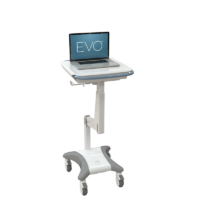
By design, EVO is a workstation on wheels (WOW), built to transport PCs (with large-screen displays) or laptop computers to the patient bedside for electronic health records (EHR) and other point-of-care applications.
So GCX engineers devised some refinements to adapt an EVO Podium model to a smartphone-driven phlebotomy workflow. They modified the cart’s worksurface with open storage compartments for blood draw supplies, and a recessed smartphone holder. They also they added a special bracket for mounting a barcode printer on top of the cart’s drawer cabinet—keeping the printer easily within reach, but off the worksurface.
The prototype impressed City of Hope’s phlebotomy team. “The vial and supply holder on the worksurface really got our attention,’ said Ruiz. “It was GCX’s idea, and we could see right away how it would save time for our phlebotomists.”
They also appreciated one of EVO’s standard features: Comfort Glide Lift Technology™, an innovative departure from the ‘straight- post’ design of most medical carts, lets nurses and clinicians adjust the height of the cart instantly, with one hand.
Comfort Glide eliminates the need for powered lift mechanisms, which can be slow, noisy, failure prone and expensive to repair— and add 20 to 40 pounds of weight to a cart. This really appealed to Ruiz.
“We really didn’t want the extra weight of a powered lift, and we really didn’t want to have powered carts that we’d have to take offline for recharging or repairs,” he said. “Once we felt how smooth and easy the Comfort Glide adjustment was, we realized we didn’t need a powered height adjustment.”
Collaborative process yields custom results
Still, the phlebotomists had plenty of tweaks to the design. To smooth the ride between buildings, they had GCX replace the cart’s standard 4” casters with 5” dual-wheel casters. They asked to move the glove box holder from the front of the cart to the back— still in easy reach, but out of the phlebotomists’ way.
And when phlebotomists made it clear that they preferred a specimen box manufactured by one of GCX’s competitors, GCX engineers designed a custom bracket for mounting the box to the
back of the cart’s worksurface.Throughout the process, the team at GCX generated photorealistic renderings of each modification and passed them to Ruiz and Salazar for comments and approval.
“The renderings, together with our rapid prototyping capability, really accelerated the custom design process,” said Gary Brayton, GCX National Sales Director. “Including the initial prototype, we were able to deliver a highly customized product to the customer in just a few
months.”Ruiz said GCX’s ability to customize was unique among the vendors they approached.
“With other vendors, our customization options were limited to the options and accessories in their catalogs,” he said. “But with GCX we could alter and customize the cart and the accessories to meet our ergonomic and patient care requirements. And we were part of the design process, which we really liked.”
Saving steps
The new carts are a hit with the team at the phlebotomists at City of Hope Duarte, and beyond.
“We’re already planning to purchase four or five more for a new outpatient facility we’re opening here in Duarte,” said Glover. “And the phlebotomy supervisor at another City of Hope location wants to purchase the same carts.”
“Everyone likes the height adjustment—it’s a big improvement,” said Salazar. “The cart is much easier to roll indoors and out. When we turn a corner or roll outside, we don’t have to worry that the phone or the printer will fall on the floor or on the ground.”
Ruiz cites some bonus benefits. “We like the cleanability, the powder coat finish,” he says. “It’s not a matte finish like other carts. It wipes clean easily. And the wheels don’t get clogged with dirt or hair, a problem we have with other carts.”
But the biggest benefit?
“The carts save steps,” says Salazar. “They save footsteps and procedural steps. The worksurface compartments save us steps back to the supply room for blood draw supplies. And the way everything is arranged, we can get everything we need—sanitizer, gloves, cotton pads, draw kits, specimen bags—without reaching into drawers so often or moving around the cart. It’s a big convenience and really makes everyone’s job easier.”